Individual ADHD Therapy for Adults in Illinois
You’ve read the books. You own the planners. That’s not why you’re stuck.
You've spent years being called too sensitive. Too scattered. Too emotional. Too much or not enough depending on the day.
What you actually have is an ADHD brain that was never given the conditions it needed, running on a self-concept built out of every time you came up short.
That's not a willpower problem. That's a shame problem. And it's the thing we work on first.

I hold advanced certification in ADHD treatment, not just general training.
Frequently Asked Questions
-
Look for someone who specializes in ADHD, not someone who "also sees" it.
ADHD adults have spent years being treated for anxiety or depression that was actually undiagnosed ADHD, and a generalist therapist will often repeat that pattern.
You want a therapist who understands masking, rejection sensitive dysphoria, executive dysfunction, and the grief that comes with a late diagnosis.
You want someone who won't make you explain what ADHD is before you can start the actual work.
And you want someone who treats the shame first, not just the symptoms, because years of "what is wrong with me" don't disappear with a diagnosis. They need their own clinical framework for that.
-
Neurodivergent-affirming therapy starts from the premise that your brain isn't broken. It's wired differently, and the work is about building a life that fits your neurology instead of forcing your neurology to fit a life designed for someone else.
Traditional therapy often treats ADHD symptoms as problems to fix. Affirming therapy treats them as information about what your nervous system needs. That means we don't pathologize executive dysfunction, we don't treat emotional intensity as something to manage away, and we don't use frameworks that were built for neurotypical brains without adapting them.
For women and AFAB adults with ADHD specifically, affirming therapy also means understanding how masking, people-pleasing, and burnout show up differently, and why so many late-diagnosed women spent years in therapy for anxiety that was never actually the core issue.
-
I work with all adults with ADHD, and a large portion of my clients happen to be women and AFAB adults who were diagnosed later in life.
The research shows women are diagnosed later, misdiagnosed more often, and carry a specific kind of shame from decades of masking in environments that weren't built for their brains. But ADHD hits hard regardless of gender. The "what is wrong with me" years don't discriminate.
If you're an adult trying to figure out how to manage ADHD, this practice was built for you.
-
Yes. I see clients virtually across all of Illinois, not just Chicago.
Online ADHD therapy removes several barriers that are especially relevant for adults with ADHD: no commute to manage, no parking to figure out, no executive function tax just to get to the appointment. You can be in your own space, with your own sensory environment, which often means you show up more regulated and more yourself.
For clients outside major metro areas, virtual therapy also means access to a specialist you wouldn't be able to find locally. Most ADHD-specialized therapists are concentrated in cities, and if you're in a smaller town or suburb in Illinois, telehealth means your options aren't limited to whoever happens to be nearby.
-
If your last therapist made you explain what ADHD is, suggested a planner, treated your executive dysfunction as avoidance, or spent a year on your anxiety without ever considering what was underneath it, that's the gap this practice exists to fill.
ADHD therapy here means I already understand your brain. You don't have to educate me. We skip the part where you prove your diagnosis is real and go straight to the work that actually matters: the shame, the grief, the relationships, the RSD, the parts of you that learned to perform "fine" at enormous cost.
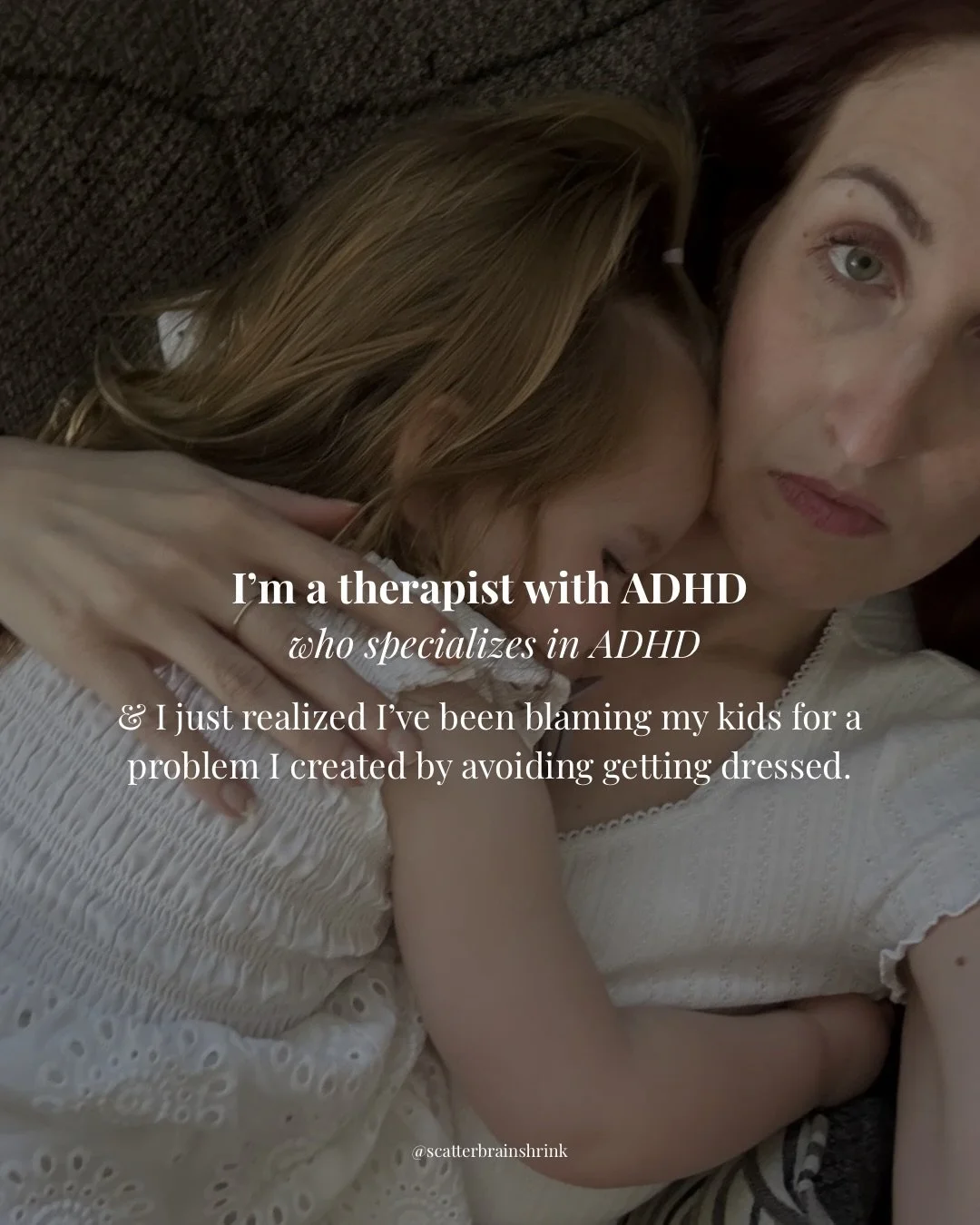
The difference isn't just that I specialize in ADHD. It’s that I have ADHD. I know the terrain from both sides of the room.
-
Most ADHD treatment starts with strategies: planners, apps, routines, accountability systems.
And most of those strategies fail, not because they're bad tools but because they're sitting on top of a self-concept built on years of "I should be able to do this and I can't." that's shame. And shame is the thing that makes every new tool feel like another setup for failure.
Shame work means we address that layer first. We look at what you internalized about yourself before you had the language of ADHD, and we start loosening shame's grip so that the practical stuff can actually land.
I use IFS-informed parts work, nervous system regulation, and RSD-specific interventions to do this. The approach is shame-first, skills second, because in my clinical experience, that's the order that actually works.
-
I'm in-network with BCBS PPO and United Healthcare. I also accept out-of-network insurance by providing superbills for reimbursement upon request. Self-pay is available as well.
-
There’s no script. Sessions are built around what's alive for you that week, which is how therapy should work with an ADHD brain.
Sometimes that's processing a shame spiral from something that happened at work. Sometimes it's RSD from an event you can't stop replaying. Sometimes it's grief about the years you lost before your diagnosis.
We use a blend of IFS-informed parts work, nervous system regulation, and practical strategies, but the ratio shifts based on what you need. Some sessions are deeply emotional. Some are concrete and strategic. All of them start from the assumption that your brain makes sense and the goal is to help you believe that too.
How the work actually goes
The first thing that happens in session is I don't ask you to explain ADHD to me. I already know. We're not spending your time or your money on 101.
The second thing is I don't treat your shame as a side effect of the "real" issue. It's the primary thing we're working on. Every tool that failed you, every planner in the graveyard, every time you tried the thing and hated yourself for not sticking with it. That's the operating system we're replacing.
The third thing is I don't perform neutrality. I have ADHD. I name harm. I have a politics and a nervous system and both of them are in the room with us. If that's going to be a problem, you'll know in the first 30 seconds and we'll save each other the time.
The clinical tools I use: IFS (Internal Family Systems) for the shame layers. Somatic and nervous system work for the reactivity. ADHD-specific frameworks for executive dysfunction that don't pretend willpower is the missing ingredient. RSD-informed work for the decisions you thought you made freely. The tools are real. The shame work is what makes them usable.

The Practical Stuff
-
50-minute sessions, virtual only, anywhere in Illinois. Same platform every week.
-
Adults 18+ in Illinois with ADHD, suspected ADHD, late-diagnosed, or AuDHD. You don't need a formal diagnosis.
-
Most clients start weekly or biweekly. We adjust as the work shifts.
-
I’m in-network with Blue Cross Blue Shield (BCBS PPO) & United Healthcare (UHC),
Self-pay rate: $160 per session.
Superbills available at request for out-of-network reimbursement if your plan covers it.

Ready When You Are.
You don’t have to have it together to reach out. That’s kind of the point.